

The future of search: discovering AI, social, and cross-platform
How AI and social media are fundamentally changing the search landscape and what this means for marketers written by Bas Noordermeer - Managing Partner Flywheel Netherlands.
Search is no longer just Google, but a behavior-driven, cross-platform playing field. Generative AI tools such as ChatGPT and Google’s AI Overviews are replacing the static results pages that dominated over the past two decades.
Instead of a list of blue links, these systems deliver dynamic, conversational responses that combine data from various sources. And Dutch consumers are following suit: a third of the Dutch indicate that their online search behavior has changed significantly over the past two years.
This article combines insights into the evolution of search with data from a study by Annalect on online search behavior in the Netherlands. The conclusion is clear: any brand that wants to be found must fundamentally reconsider its search strategy.
The new search landscape is cross-platform
Google processes about 13.7 billion searches daily, while ChatGPT now processes about 2.5 billion prompts per day. Searches and prompts are not identical, but the volumes are becoming increasingly significant and usage appears cumulative: consumers are submitting more and more AI prompts and simultaneously performing more searches in Google. Search is becoming increasingly ‘conversational’. As a result, ‘online visibility’ takes on a different meaning, and the interplay between paid and organic results is changing.
In the Netherlands, the search landscape is just as diverse. Almost all Dutch people (78%) regularly search online for products and services, with more than a third doing so daily. But ‘online searching’ has long ceased to be synonymous with ‘Googling’. The monopoly of the traditional search engine appears to have been broken. And not by a single new competitor, but by an ecosystem of alternatives.
“A third of the Dutch now use AI tools to find information about products and services. Two years ago, this was only 2%.”
Google remains by far the largest player: 86% of the Dutch use the platform to search for products and services, and 72% still name it the most useful platform. But the rise of alternatives is undeniable. Currently, 33% of the Dutch use AI tools such as ChatGPT as a search engine, 32% YouTube, 26% Instagram, and 13% TikTok. The shift has been particularly rapid: for instance, two years ago only 12% used YouTube as a search engine, now that figure is 32%.
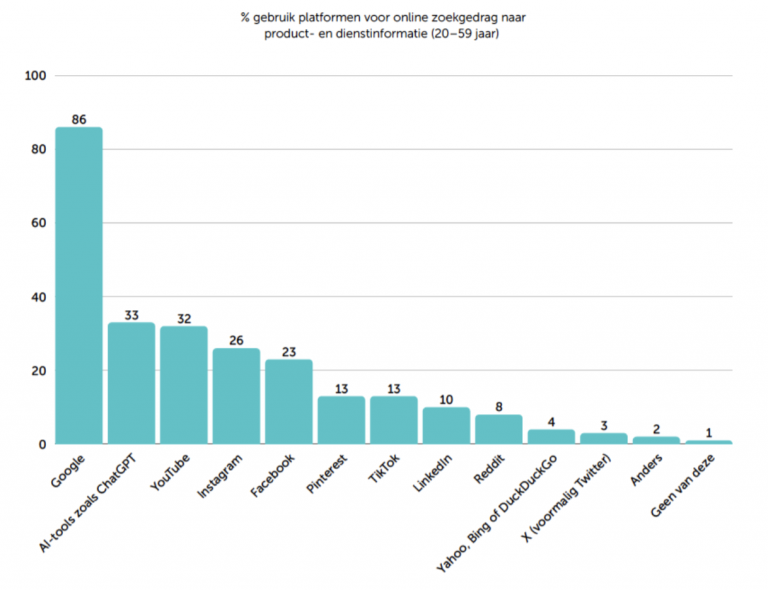
Annalect, onderzoek Online Zoekgedrag 2025
Search behavior is no longer linear
Consumers are increasingly switching between AI tools, social platforms, and e-commerce, leading to so-called ‘messier journeys’. To be discoverable with a brand, one must therefore capitalize on non-linear multitouch and multimodel journeys, in which (AI) platforms such as ChatGPT, TikTok, and Bol.com each play a distinct role in the search process.
This pattern is also reflected in the Dutch data. Platforms are used with different intentions, attract different target groups, and require fundamentally different approaches. Social media has undergone a metamorphosis: platforms that were previously used primarily for entertainment now also function en masse as search engines for inspiration and information.
The customer journey looks completely different per product category. For electronics, 39% start at online stores such as Bol.com, the only category where Google is not the most popular starting point. For holidays, 56% still start at Google.
Measuring success is becoming an increasing challenge
SEO may be maturing, but one of the most profound structural shifts is what is known as ‘the great decoupling’: Google’s impression volumes continue to rise, while clicks are declining. Zero-click search is increasingly becoming the norm, as decisions are made within AI-generated responses without the user visiting a website.
This makes website traffic less reliable as a measure of success. Measurement is further complicated by the fact that consumers move across an increasing number of channels. Within AI models, visibility and share of voice are the new KPIs, but in a world where consumer behavior spreads across multiple search engines and platforms, the focus must ultimately shift to what counts at the bottom line: revenue and customer loyalty.
Implications and recommendations for marketers
The implications can be far-reaching for a marketing team. After all, the influence and visibility of a brand within AI responses are now just as important to marketers as the number of website visitors, and therefore they are resorting to new tactics that impact organic authority.
The consequences for a marketing team can be significant. The presence of a brand in AI responses is now just as important to marketers as website traffic, causing them to deploy new strategies to strengthen their organic authority.
Marketers must therefore now prepare for a world in which brand visibility within AI-driven platforms is converted into conversions. Differentiation and trust are therefore essential when consumers rely on a single AI-generated response.
Five concrete recommendations to better respond to changes in the search landscape:
Simply being ‘everywhere’ is not enough. Different platforms are used with different intentions and attract different target audiences. A successful cross-platform search strategy requires an understanding of where your target audience is and why.
Work on your brand recognizability. Uniformity in design, identity, tone of voice, and brand values plays a major role within a cross-platform approach. Therefore, work closely with the CXO specialist.
Put your target audience even more at the center. The age, interests, questions, and gender of your target audience determine your strategy. A one-size-fits-all approach is doomed to fail.
Every product category requires a different approach. The customer journey looks completely different per category. Adapt your approach accordingly and make it easy for your target audience to take the next step.
Work across channels. Broad visibility on multiple platforms can only be achieved with a joint content agenda and close collaboration between PR, paid media, email, and other relevant channels, because ultimately you are all working towards the same goal.
Cross-platform search requires an organizational and strategic approach
The findability of a brand or product is increasingly less a purely SEO issue. In practice, visibility requires close collaboration between SEO, PR, paid, social, and e-commerce teams. Factors such as expertise, authority, and trustworthiness play an important role in this, as do a consistent user experience and recognizable brand communication across various channels.
Conclusion
Brand visibility is shifting rapidly across AI, Social, and e-Commerce platforms. Dutch data confirms this: a third of the Dutch population has already fundamentally changed their search behavior, rising to nearly half among the youngest generation. Search is therefore more than ever a behavior, not a channel.
Brands that adapt with integrated cross-platform strategies, clear E-E-A-T signals, and the willingness to embrace agentic ecosystems are best positioned to grow. The question is not whether you need to transform, but how fast.