

Social Search in 2026: Why Brands Need to Be Discoverable Beyond Google
Social platforms are no longer just a place where content is consumed. They are where people search, compare and make decisions.
Search behaviour is becoming more fragmented, and social platforms are now part of that shift. TikTok, for example, reports a 40% year-over-year increase in daily search activity [1], with around 35% of users actively coming to the platform to search. At the same time, broader research shows that 46% of Gen Z and 35% of millennials prefer using social media over traditional search engines for discovery [2].
This reflects a change in how users approach discovery, especially in categories where visual proof, reviews and real experiences matter.
For brands, this changes what discoverability means. It is no longer enough to show up in traditional search engines. Brands also need to be visible where intent is expressed, on social platforms. The question is no longer if you should invest in social search, but whether you can afford not to.
Search no longer starts in one place.
In 2026, consumers move fluidly among Google, social media, and AI tools, depending on what they want to know. For brands, that shifts what discoverability actually means.
Social media is no longer just where people consume content. It is increasingly where people search, compare, validate, and decide. That means brands can no longer treat social media only as a channel for reach and engagement. It is also becoming a channel for search and discovery.
For brands, that shift should matter.
What is social search?
Social search refers to the behaviour of using social platforms to actively look for information, products, recommendations or opinions.
Instead of typing a query into Google, users increasingly search directly inside platforms like TikTok, Instagram or YouTube to find answers in a format that feels faster, more visual and more human.
This could be anything from:
“best running shoes for flat feet”
“Amsterdam restaurant review”
“how to style wide jeans men”
“is brand X worth it?”
“best protein yogurt Netherlands”
These are not passive scrolling moments. They are active intent moments. That is what makes social search relevant.
Why are people using social platforms to search?
The reason is simple: people increasingly want proof, not just information. Traditional search engines still play an important role in finding facts, websites, and quick answers. But for many discovery-led questions, users increasingly prefer platforms where they can quickly see experiences, opinions, and demonstrations. Social search works well because it offers:
1. More human answers
People trust people more than polished brand messaging. User-generated content, creator opinions and comment sections will make information feel more relatable and credible.
2. Faster understanding
A short video can often answer a question faster than a long article or product page.
3. Visual proof
Users can see how a product looks, how it works, how it fits, or what the real-life experience is like.
4. Multiple perspectives
Social search makes it easy to compare reviews, opinions and use cases in a short amount of time.
5. A mobile-first experience
Social search fits naturally into how people already browse on their phones. It is fast, intuitive and native to everyday behavior.
This behavior has been especially visible among younger audiences, but it is increasingly broader than Gen Z alone. Google itself acknowledged the shift when it noted that younger users were increasingly turning to TikTok and Instagram instead of Google.
Why social search matters for brands
This shift changes the role of social content. For years, social media content was primarily evaluated based on feed performance, reach, engagement, views, and clicks. While these metrics still matter, they no longer tell the whole story. In a social search environment, content must also be judged by its discoverability when users have intent. This shifts the competition from just capturing attention in the scroll to also standing out when users actively seek answers, comparisons, or reassurance.
That matters for brands for three reasons:
1. Your content can answer demand, not just interrupt it
Some of the most valuable content is not the content that stops people. It is the content that gets found when people are already looking.
2. Good content can keep working for longer
Unlike trend-led content that peaks quickly and disappears, searchable content can continue delivering value over time if it stays relevant.
3. Brand perception is increasingly shaped before users ever visit your website
When people search your brand, category or product on social platforms, they do not only find your ads or owned content. They may also find:
creator reviews
customer experiences
comparisons
complaints
tutorials
community opinions
That means social search is not only a discoverability issue. It is also a brand perception and reputation issue.
Social search is not the same as traditional SEO
This is where many brands oversimplify the topic. Social search is not just “Google SEO for TikTok”. Traditional SEO and social search overlap in some areas, but they are not driven by the same logic.
Traditional SEO typically focuses on:
relevance
authority
backlinks
site structure
technical health
page experience
Social search is more content-native and platform-native
It is influenced by whether the platform can understand what the content is about and whether users find it worth watching, engaging with or returning to. While every platform works differently, the main signals often include:
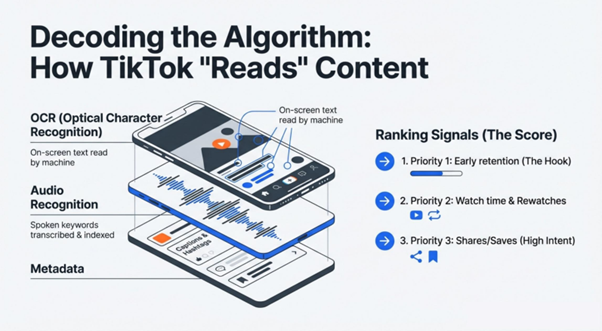
In other words, platforms are not just indexing content. They are trying to understand whether it satisfies the user’s intent. That changes how brands should create content.
What brands should do differently in 2026
This is where social search moves from trend to strategy. If discoverability is increasingly happening inside social platforms, then content planning needs to evolve with it.
1. Plan content around search behaviour, not just campaigns
Brands should not only ask, “What do we want to say?” They should also ask:
What are people already trying to understand in our category?
What are they comparing?
What are they uncertain about before they buy?
What would they search if they did not know our brand yet?
That is where social search becomes commercially useful.
2. Create for category intent, not only brand intent
Users often search the need or the problem before they search your brand. That means brands need content that speaks to broader decision-making moments, not only brand messaging.
3. Build a searchable content layer
Not every post should be trend-led or campaign-led. Some content should be designed to stay useful and discoverable over time (evergreen content), for example:
explainers
product comparisons
tutorials
use cases
FAQs
review-style content
creator-led demonstrations
4. Prioritize clarity over cleverness
Searchable content needs to be easy to understand quickly. If the content is too abstract, too brand-heavy or too dependent on prior context, it becomes harder to find and less useful when users land on it from search.
5. Audit what people actually find
One of the most overlooked questions in social strategy today is: What shows up when someone searches for us? Whether brands like it or not, users are already building perception from what they find there.
Why paid social also matters in social search
This is where the conversation often gets too narrow. Social search is not only an organic content opportunity. It is increasingly relevant from a paid social perspective as well. As platforms continue investing in search behaviour and discovery surfaces, brands have more opportunities to align:
organic content
creator content
paid media
search intent
That matters because the strongest paid social strategies are no longer only built around interruption. They are increasingly built around intent and relevance.
For brands, that means paid social should not only amplify campaign messages. It should also support the moments where users are actively exploring, comparing and validating. This is especially relevant on platforms like TikTok, where search behaviour has become a more visible part of both the user journey and the platform’s advertising proposition.
In practice, that means brands should think more deliberately about:
search-led creative angles
problem/solution messaging
review and comparison content
creator content that answers real category questions
paid support behind content that already reflects existing demand
This is where social search becomes more than a content trend. It becomes a media and discoverability strategy.
If you want to know more about Social Search or social media strategy, send me an email and let’s have a chat.
Tage Langhelle | Team Lead Paid Social | Tage.Langhelle@kinesso.com
[1] Marketing Science Global, Future of Search Study 2025 (US results), conducted by WARC