

Advertising in AI Chatbots: The Next Distribution Layer for Brands (and What Marketers Should Do Now)
AI chatbots have moved from novelty to default interface in record time. For a growing share of questions, especially exploratory, comparative, and intent-shaping ones, people now start with ChatGPT, Google Gemini, or Microsoft Copilot instead of Search, marketplaces, or a retailer’s site.
When marketers talk about AI, the conversation often collapses into one question: How do we get our brand mentioned “organically” by a chatbot?
That discipline, commonly labeled GEO (Generative Engine Optimization), matters, but it’s not the focus here. This article takes a different angle: the emergence of paid placements inside AI interfaces. What is already live globally, what signals are coming next, and why this is no longer a speculative topic for marketing and media leaders.
What exactly are we talking about?
This is not a guide to “ranking” in AI answers. It’s not about prompt tactics, content tweaks, or hoping an LLM mentions your brand by chance.
What we are talking about is the paid media layer inside AI:
Paid placements served within AI interfaces (chatbots and AI-powered search experiences)
Explicit Sponsored labeling designed to preserve trust and transparency
Contextual placements adjacent to (or lightly integrated with) AI-generated answers
Bought via existing ad ecosystems—pilot mechanics today, scalable buying tomorrow
In other words: AI chatbots are becoming a new media distribution layer, and that means a new media surface, not an SEO side quest.
How big is this behavior already?
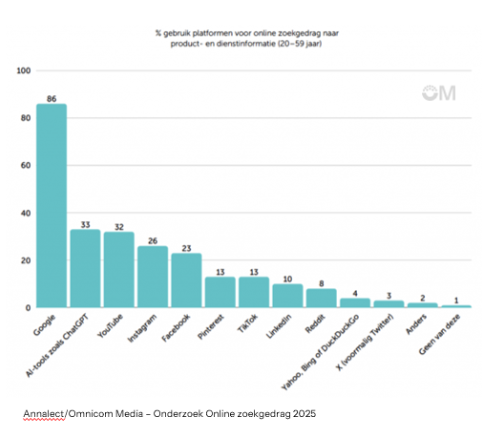
The narrative that AI chatbots are “still niche” is quickly becoming outdated. Across multiple studies (including a recent study by Omnicom Media), a consistent pattern is emerging:
ChatGPT is the most-used GenAI platform globally for product- and service-related questions (58% of usage).
Google Gemini (31%) and Microsoft Copilot (22%) are growing fast, driven in part by deep integration into existing ecosystems (Search, Chrome, Windows, Office).
Consumers are using AI interfaces more and more:
in the consideration phase
for comparisons
for advice (“what’s right for me?”)
That last use case, advice, matters disproportionally. These are high-value moments where brands have historically captured demand and shaped preference through Search, Display, and content. AI won’t eliminate those behaviours, but it is re-routing a meaningful share of them. And whenever behaviour migrates, media and budgets follow.
The key players and what their ad moves signal
OpenAI – ChatGPT
OpenAI is quickly turning “ads in AI” from a concept into a real, operating market.
In the US, advertising is already live in pilot form, with high entry thresholds (around $200,000) and premium CPMs (~$60). For now, exposure is limited to free and lower-tier users, while partnerships like Criteo signal a clear ambition toward commerce-driven applications. Major advertisers are already participating—more than 30 Omnicom clients included—indicating this is structured testing rather than experimentation at the edges.
The format itself is intentionally subtle: ads appear below the AI response, clearly labelled as Sponsored, with a simple combination of title, description, and image. They are designed to complement the answer without interrupting it.
What comes next is scale. Minimum budgets are expected to drop, a dedicated ad manager is on the horizon, and rollout will expand to markets like Canada, Australia, and New Zealand. The Netherlands is not live yet—but the trajectory is clear.
At this point, the question is no longer if AI advertising will scale, but how fast.
Google – Gemini, AI Overviews, and AI Mode
Google may ultimately be the most important player in AI advertising—not by launching a separate chatbot, but by embedding AI directly into Search. This allows AI-driven ads to scale where user intent already exists.
The distinction is clear: Gemini, as a standalone product, has no ads and no confirmed plans to introduce them. In contrast, AI Overviews and AI Mode are fully tied into the existing Google Ads ecosystem. Campaigns using Broad Match, Performance Max, and Shopping are automatically eligible, meaning advertisers are already part of this shift.
Ads can appear above or below AI-generated answers, and within AI Mode itself. In the Netherlands, placements around AI Overviews are already live, while deeper integrations are still rolling out globally.
What makes this approach so significant is that it does not feel like a new channel. The underlying systems—targeting, bidding, measurement—remain the same. Only the interface has changed.
Microsoft – Copilot & Copilot Search (Bing)
Microsoft may be the most quietly relevant player for European advertisers. By positioning Copilot as both a productivity tool and a search layer, it is creating new moments of commercial intent—often without users ever leaving the interface.
Today, there are no ads in the Copilot Business App, but advertising is already present across Copilot Web, Copilot Search, and Bing AI Overviews. Formats mirror the existing ecosystem: search ads, product ads, and multimedia placements. Importantly, advertisers do not have direct control here. They cannot choose to specifically target Copilot, nor is delivery within AI environments guaranteed—ads are simply integrated automatically from existing campaigns.
In the Netherlands, these placements are not live yet, but rollout is expected in the near term.
Beyond Microsoft, the landscape is less active. Platforms like Claude and Apple Intelligence have no advertising and no stated plans, while Perplexity has only briefly tested formats. Meta AI does not show ads either, although interactions still feed into its broader advertising engine.
The pattern is clear: not every AI product will become an ad platform. But those that already monetize attention at scale—like Microsoft and Google—are steadily turning AI interfaces into commercial environments, shaped by trust, transparency, and relevance.
Why this is already relevant for Dutch advertisers
A common reflex is: “Interesting, but this is a US story.” We’ve heard that before for social, video, retail media. Each time, the late adopters didn’t just miss scale; they missed the learning curve that shapes strategy, creative, and measurement. The shift is already underway even before full Dutch rollout:
Platforms are defining the “rules of trust” for ads next to AI answers: additive, contextual, clearly disclosed not a banner-style interruption.
Early pilots are already mapping where AI ads create value discovery, comparison, inspiration and where they underperform.
Buying won’t start from zero: expect AI inventory to plug into familiar stacks (Google Ads, Microsoft Advertising, commerce partners) with new placement logic.
The governance conversation is maturing: from whether ads belong in AI to how to do it transparently, safely, and in a way that protects user trust.
In other words, this isn’t primarily an execution challenge yet it’s a strategic design moment. The brands that develop a point of view now will be faster to decide where AI ads add value, how to brief creative for answer-led environments, and how to adapt measurement as “clicks” stop being the only output.
And this raises new questions…
In a follow-up article, we’ll share early learnings from AI chatbot advertising pilots in the US. But the bigger opportunity is to broaden the agenda from tactics to strategy.
For example:
What role do AI chatbots play in holistic media planning?
Where does this fit in the funnel: upper, mid, lower… or something new?
Which KPIs are even relevant here?
How do you compare performance with Search, Social, and Retail Media?
And: how do you evaluate a channel that gives answers instead of just clicks?
Can this channel be included in MMM studies?
What place has advertising within Agentic AI?
AI chatbots force a rethink of media not because it’s trendy, but because interface change is behavior change. And in marketing, behavior is still the only thing that compounds.